
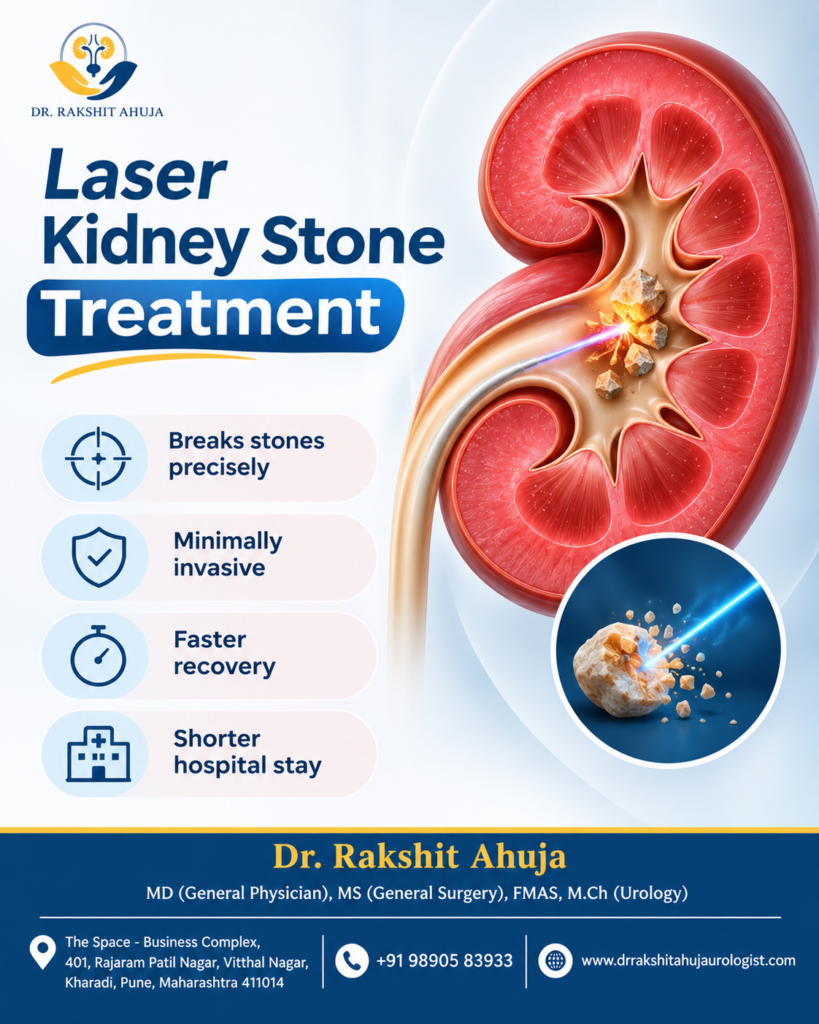
Kidney stones can vary considerably in size, location and composition. While some smaller stones may pass naturally, others may remain stuck in the urinary tract, cause recurring symptoms or interfere with urine flow. In such situations, a urologist may recommend a procedure to remove or break the stone.
Laser Kidney Stone Treatment in Pune is one of the minimally invasive approaches used for selected kidney and ureteric stones. The exact procedure depends on factors such as the stone’s size, location, symptoms and the patient’s overall health.
What Is Laser Treatment for Kidney Stones?
Laser stone treatment is commonly performed using a technique called ureteroscopy. A thin telescope, known as a ureteroscope, is passed through the natural urinary passage into the bladder and then towards the ureter or kidney.
When the stone is identified, a fine laser fibre can be used to fragment it into smaller pieces. Depending on the situation, fragments may be removed using a small basket or allowed to pass naturally after being broken into smaller pieces.
The procedure does not usually require an external incision on the skin because access is through the urinary passage. However, the suitability of this approach varies from patient to patient.
When May Laser Stone Treatment Be Considered?
Not every kidney stone requires a procedure. Smaller stones may sometimes pass naturally, particularly when they are not causing significant symptoms or complications.
A procedure may be considered when a stone:
- Does not pass naturally
- Causes persistent or significant pain
- Blocks urine flow
- Is associated with repeated urinary infections
- Affects kidney function
- Has a size or location that makes spontaneous passage unlikely
The treatment decision is generally based on imaging findings, symptoms, stone characteristics and kidney function rather than stone size alone.
How Does the Procedure Work?
During ureteroscopy, the urologist uses a small camera to locate the stone. A laser fibre can then fragment the stone into smaller pieces.
Depending on the circumstances, the fragments may be removed using a basket or reduced into very small particles. A temporary ureteric stent may sometimes be placed after the procedure to help urine drain from the kidney while the urinary tract recovers.
The need for a stent and the duration for which it remains in place depend on the findings during the procedure and the urologist’s assessment.
What Are the Advantages of a Minimally Invasive Approach?
One important advantage of ureteroscopy is that the urinary tract can be accessed without making a traditional external surgical incision. This allows the urologist to directly visualise the stone and treat it under controlled conditions.
Laser technology can provide precise fragmentation of suitable stones. However, no single treatment is appropriate for every patient. For some larger kidney stones, other procedures such as percutaneous nephrolithotomy may be more appropriate.
Therefore, treatment should be selected after reviewing the stone’s characteristics and the patient’s individual medical situation.
What Can Patients Expect After Treatment?
Recovery varies according to the procedure performed, stone burden and individual health factors. Some patients may experience temporary urinary discomfort, increased frequency or mild blood in the urine following ureteroscopy.
If a ureteric stent is placed, it can sometimes cause urinary symptoms until it is removed. Patients should follow the treating urologist’s instructions regarding medication, hydration, activity and stent removal.
Follow-up may also be recommended to check whether any residual stone fragments remain and to assess the urinary tract.
Can Kidney Stones Come Back?
Treatment removes or manages the existing stone, but it does not necessarily eliminate the possibility of developing another stone in the future.
People with recurrent stones may benefit from evaluation of their hydration habits, dietary factors, medical history and stone composition. Depending on the individual situation, additional testing may help identify factors that contribute to repeated stone formation.
Maintaining appropriate fluid intake is generally an important part of kidney stone prevention, although fluid requirements should be personalised for people with certain medical conditions.
When Should You Consult a Urologist?
Persistent or severe pain, blood in the urine, repeated urinary infections, difficulty passing urine, fever with urinary symptoms or known urinary obstruction should not be ignored.
Early assessment can help determine whether observation, medication, shock wave treatment, ureteroscopy or another procedure is appropriate.
Patients can discuss their symptoms, scan reports and treatment options during a consultation. The most suitable approach depends on the individual’s stone characteristics and overall health.
Frequently Asked Questions
Is laser treatment suitable for every kidney stone?
No. Treatment depends on the stone’s size, location, symptoms and other clinical factors.
Does laser treatment involve an external cut?
Ureteroscopic laser treatment generally accesses the urinary tract through the natural urinary passage rather than through an external skin incision.
Can a stent be required after the procedure?
A temporary ureteric stent may be placed in selected cases. The decision depends on the procedure and findings.
How do I know which kidney stone treatment is right for me?
A urological evaluation with appropriate imaging and clinical assessment helps determine the most suitable treatment option.