
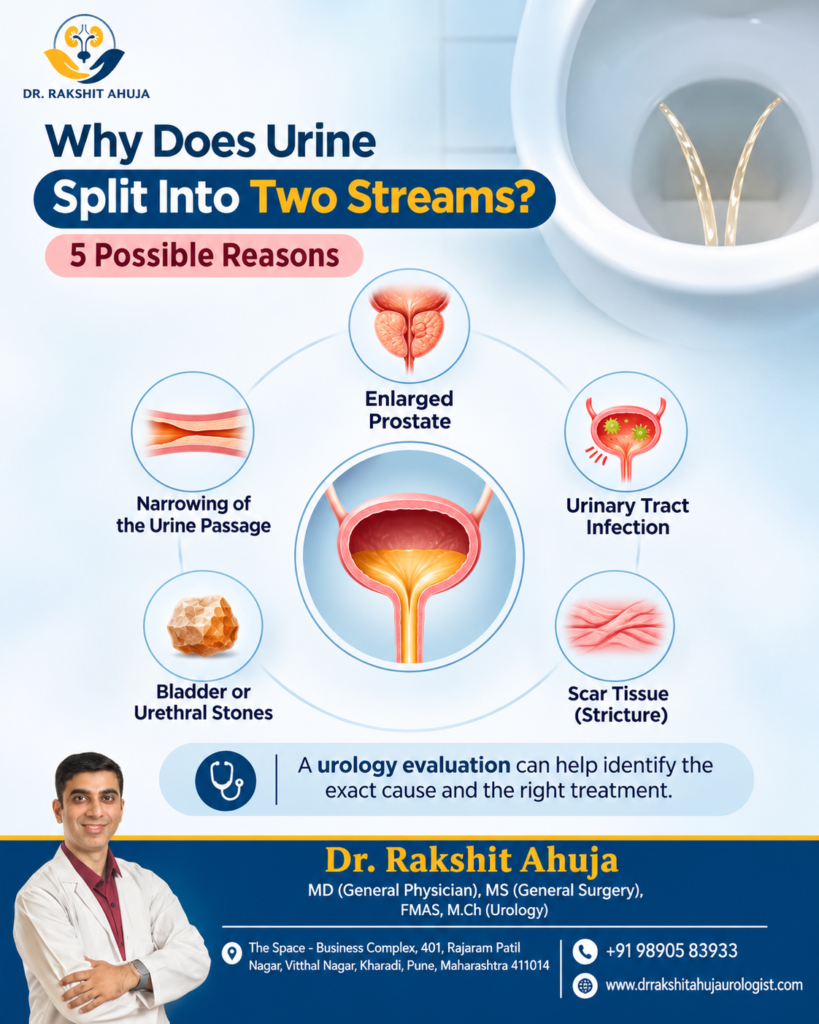
Urination is usually a simple and predictable process. However, some people notice that their urine stream suddenly divides into two streams, sprays in different directions or becomes difficult to control. While an occasional change may be temporary, a repeatedly divided stream can sometimes point to an issue affecting the urinary passage.
A split urine stream does not automatically mean that there is a serious medical problem. The reason can range from a temporary change at the urinary opening to conditions affecting the urethra, prostate or bladder. Understanding the possible causes can help you decide when professional evaluation may be useful.
What Causes a Split Urine Stream?
The urinary system is designed to allow urine to travel from the bladder through the urethra and out of the body. Any change in the shape, opening or passage of the urethra can potentially alter the direction or pattern of urine flow.
Here are some possible reasons.
1. Temporary Adhesion at the Urinary Opening
Sometimes the edges of the urethral opening can temporarily stick together. This may happen because of dried secretions or semen around the opening.
In such cases, the urine stream may divide briefly and then return to normal. A temporary split that disappears quickly and does not occur repeatedly may not indicate an underlying disease.
However, if the change keeps returning, it is worth paying attention to other urinary symptoms.
2. Narrowing of the Urethra
The urethra is the tube through which urine leaves the body. Scar tissue can cause a section of the urethra to become narrower, a condition known as a urethral stricture.
A stricture may affect the strength and direction of urine flow. People may also experience a weak stream, difficulty starting urination, straining, discomfort or a sensation that the bladder has not emptied completely. Previous injury, inflammation, infection, catheterisation or certain medical procedures can contribute to urethral scarring.
When these symptoms persist, a urological assessment can help determine whether narrowing is present.
3. Changes Around the Urethral Opening
A narrowing of the urinary opening, known as meatal stenosis, can affect the direction and shape of the urine stream. Some people may notice a narrow or spraying stream, difficulty aiming the urine or difficulty completely emptying the bladder.
The condition is not common in adults, but when present, it can affect normal urine flow.
The appearance of the stream alone cannot confirm the diagnosis. A clinical examination is needed to understand the underlying cause.
4. Prostate Enlargement
As men age, the prostate may gradually become enlarged. Benign prostatic hyperplasia, or BPH, can affect urine flow by putting pressure around the urinary passage.
Common urinary symptoms associated with prostate enlargement include a weak stream, difficulty starting urination, frequent urination, urgency, dribbling and incomplete bladder emptying.
A divided stream may therefore occur alongside other prostate-related urinary symptoms. However, a split stream by itself does not mean that a person has prostate enlargement.
5. Infection, Stones or Other Urinary Tract Changes
Inflammation or infection affecting the urinary tract can sometimes change urinary symptoms. Stones within the urinary system may also interfere with normal urine flow, particularly when they cause obstruction.
Other structural changes can affect the urinary passage as well. This is why persistent urinary symptoms should not be diagnosed based on one symptom alone. A urologist may consider the person’s symptoms, medical history and appropriate tests before identifying the cause.
When Should You See a Urologist?
An occasional split stream that quickly returns to normal may not require immediate investigation. However, repeated or persistent changes deserve more attention, particularly when they occur together with other urinary symptoms.
Consider discussing the problem with a urologist if you notice:
- Repeatedly divided or spraying urine
- A weak or slow urine stream
- Difficulty starting urination
- Straining while passing urine
- Burning or discomfort during urination
- Frequent urinary infections
- Blood in the urine
- A feeling that the bladder has not emptied completely
- Difficulty passing urine
Sudden inability to pass urine requires prompt medical attention because acute urinary retention can be an emergency.
How Is the Cause Evaluated?
The evaluation depends on the symptoms and medical history. Your doctor may ask when the change started, whether it happens every time you urinate and whether you have other urinary symptoms.
Depending on the situation, investigations may include a urine test, ultrasound, measurement of urine remaining in the bladder after urination or uroflowmetry. Uroflowmetry measures how quickly urine flows and can provide information about problems with urine flow or possible obstruction.
If a urethral narrowing is suspected, additional testing may be required to assess the location and severity of the narrowing.
Should You Ignore a Split Urine Stream?
Not necessarily. A temporary change can have a simple explanation, but a persistent or repeatedly divided stream deserves attention, especially when accompanied by weak flow, discomfort or difficulty emptying the bladder.
Self-diagnosing the cause based only on the direction of the urine stream can be misleading because several different urinary conditions can produce similar symptoms.
Dr. Rakshit Ahuja, Urologist & Andrologist, provides consultation for urinary, bladder, prostate and kidney-related concerns at The Space – Business Complex, 401, Rajaram Patil Nagar, Vitthal Nagar, Kharadi, Pune, Maharashtra 411014.
If you are wondering Why Does Urine Split Into Two Streams?, a proper urological evaluation can help identify whether the change is temporary or related to an underlying urinary condition and guide appropriate care.
Frequently Asked Questions
Is a split urine stream always a sign of a disease?
No. A temporary divided stream can occur because of temporary adhesion around the urinary opening. Persistent or recurrent changes may have other causes and should be evaluated when accompanied by additional symptoms.
Can an enlarged prostate cause changes in urine flow?
Yes. Prostate enlargement can contribute to weak or interrupted urine flow and other lower urinary tract symptoms. However, a split stream alone cannot establish that prostate enlargement is the cause.
Can a urethral stricture affect urine flow?
Yes. A urethral stricture narrows the urinary passage and can cause a weak or slow stream, difficulty urinating and incomplete bladder emptying.
What test can measure urine flow?
Uroflowmetry is a non-invasive test that measures the speed and pattern of urine flow. It may help doctors assess problems with urine flow and possible obstruction.